Monday, February 23, 2015

ceremony part 2

As part of the Laguna Pueblo culture, actions of one effect the whole community. Tayo's mom is a great example of how they all feel at fault when one strays from the culture. "The Catholic priest shook his finger at the drunkenness and lust, but the people felt something deeper: they were losing her, they were losing part of themselves" (Leslie Marmon Silko 63). They are all connected and feel the blame when one assimilates to white culture and leaves their native beliefs behind. The Laguna people take it upon themselves to fix the problem and don't leave her on her own to deal with things herself. "For the people, it was simple, and when they failed, the humiliation fell on all of them;what happened to the girl did not happen to her alone, it happened to all of them" (Silko 63). The community is all connected and it is not just about the individual. His mom went thought what many natives did during this time period. They were all put in catholic schools where they were forces to assimilate and caused them to lose both cultures and be in a shadow world. "Shamed by what they taught her in school about the depolarable ways of the Indians" (silko 63). They were taught they their ways were wrong and so being native was wrong but they were also not accepted in the white culture as equals so they were left with nothing and no place to feel at home.


Natives were always went to the worse areas or war and separated from the white soldiers. There was racism even when it came to wanting to fight for the same country. "Anyone can fight for america,' he began, giving special emphasis to 'America,' 'even you boys, In a time of need, anyone can fight for her" (Silko 59). Even thought he is not trying to be raciest, the recruiter is saying that they are different and will be taken but not necessary wanted. He talks to them in a manner that puts them on a different level than white soldiers. "Now I know you boys love america as much as we do, but this is your big chance to show it!" (Silko 59) He makes it so they are not they same by saying "as much as we do". they are separated, us and them. Natives as well as African Americans were a;ways sent to the worse war zones that had terrible conditions. They were never able to rank up or be anything other than a soldier on the front line. "I want to be a pilot.' he paused and look at the recruiter. The recruiter didn't look up.'Sure, sure,' he said 'you enlist now and you'll be eligible for everything" (Silko 60) They would lie and promise that they could be anything they wanted but that was never the case. Natives were separated and not giving equal opportunity that white men got.


Wednesday, February 18, 2015

Reel Injun

There are still many stereotypes around native nations, especially in cinema, but they have grown and evolved overtime. During the 50's and the time of the John Ford movies, the Indian was always depicted as savage. Jim Jarmusch went against this by saying" I wanted to make an Indian character who wasn't...the savage that must be eliminated, the force of nature that's blocking the way for industrial progress"(Reel Injun) Movies always depicted natives as uncivilized and in the way of the correct way of doing stuff. Later, in the time of the cowboy, Indians were always the losers. Jesse Wente says "When you're kids and you're trying to play Cowboys and Indians, and if you're an Indian kid-well, doesn't that mean you're going to lose all the time?" (Reel Injun) Natives were never view as the hero or the "good guy", they were the enemy; the one the hero always had to defeat. In the next era, natives were all depicted as warriors. Adam Beach says "We'll never be able to change the fantasy of who and what Indians are. That fantasy will always be there, we will always be on the cover of novels saying 'Cheyenne Warrior'" (Reel Injun) The ideas and fantasies of Indians in all the different eras will always live on. It is not that as a new depiction comes along the old one is forgotten. All of these accumulate and the stereotypes just grown instead to change.


The renaissance time period was the start of the new native movies. These movies were made by natives for the native community. Chris Eyre says that the movies "tell out stories, our way" (Reel Injun). Native stories were no longer only be told from the outside and the perspective of someone that was in within the community. The real stories that were being pasted down though generations were now the ones being told in films. The films were not only about the stereotypes or trying to break them. Adam Beach says they are about "human beings showing human emotion" (Reel Injun). These films took way from the controversy and stereotypes and just focused on the stories and characters. It did not matter that they were natives, they were human beings and that was what was depicted. Unlike Smoke Signals, that was made to show the reservation as it was at that time, The Fast Runner was made to persevere history. Natives started using film as a way to record their history in a community were these stories were always just passed down by story telling and never written.  These stories meant something to the directors and actors to the point where they would do anything to tell the story. "That's not an actor, cause an actor wouldn't do that" (Reel Injun).  In this quote Chris Eyre when the fast runner ran across ice with bare feet in the freezing cold. There were no effects, the actor really did it. He endured this in order to make the movie they way the story has always been told. The Fast Runner has permanently preserved the stories that would have vanished with it.


Monday, February 2, 2015

Ceremony- Leslie Marmon Silko

Thought out the beginning of the book the reader gets a scene of the racism in Tayo life and how war has made that fade in his eyes. War made all the soldiers connected to thee point where there was no race. "The humid air turned into sweat the had run down the corporal's face while he repeated his dream to them. That was the first time Tayo had realized that the man's skin was not much different from his own". (Leslie Marmon Silko 6) The conditions were so terrible it made a little difference like race not matter, they were connected though the hard situation they were all in. The things they were experiencing were so brutal that it made skin color unrecognizable. "even white men were darker after death. There was no difference when they were swollen and covered with flies". (Silko 7) Tayo realized that all the racism he grow up with was insignificant, people were dying no matter what race they were. Tayo even noticed there was no difference between the Japaneses soldiers and himself. "Tayo started screaming because it wasn't a Jap, it was Josiah, eyes shrinking back into the skull and all their shining black light glazed over by death" .(Silko 7) Tayo saw his uncle when he looked at the Japennse soldier that had been killed. He saw the connection they had, and that race did not set people apart or make one better than another. Tayo grow up with racism but going to war and living though such a hard time with men of other races made him open his eyes to the fact that there are no differences.


Many believe that story telling is a important way to heal. This is a strong belief in the Laguna Pueblo religion. "They aren't just entertainment. Don't be fooled. They are all we have, you see, all we have to fight off illness and death. you don't have anything if you don't have the stories" . ( Silko) Stories are a reminder of who you are and a source of hope when you have nothing left. They connect you with your past and shine light on your future and that is why they can be so healing. "he could not feel anything except a swelling in his belly, a great swollen grief that was pushing into his throat". (Silko 8) Tayo was feeling physically ill and need to tell his story and relive the grief he had been holding in and enduring all alone. Stories don't just heal after a tragic event, they also help support you though a tough situation. "He made a story for all of them, a story to give them strength. The words of the story poured out of his mouth as if they had substance, pebbles and stone extending to hold the corporal up, to keep his knees from buckling, to keep hid hands from letting go of the blanket". (Silko 11) stories are a way to distract and detach people from the suffering they are going thought and give them hope as something to look forward too.

Friday, January 23, 2015

Dancing With Wolves part 2

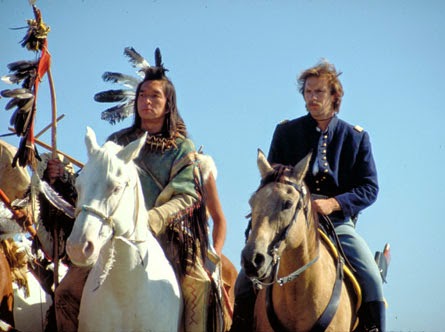
Dancing With Wolves uses pathos to connect the viewer to the struggles and hardship the Sioux went thought when settlers came to their land. There is a scene where Lt.Dunbar dance around a fire when he returns from his time with the tribe. Before this was seen as savage but this film made it a beautiful scene that showed Dunbar connecting with the tribe and also spiritually to nature. Another use of pathos in the movie is Two Socks; the wolves. When he is killed it shows the senseless killing and pain. Killing another for no other reason than not understanding each other. There was no respect, pain and killing was done for sport. The movie also uses pathos to get the viewer to really think about the to very different cultures and how they clash. In the scene where the Sioux found the buffalo the settlers had killed just for there fur and tongues, it shows the differences in views the two cultures have. The natives respect everything they kill and never waste any part of the animal. The settlers on the other hand just kill them so they can make a profit and don't worry about the rest of the animal that could help preserve the Sioux way of life. The scene is so sad and heartbreaking that it makes one think about how the two sides are so different and the violence that came from that.


Dancing With Wolves breaks a lot of stereotypes surrounding native nations but still misrepresents the tribe throughout the movie. The movie makes it seem that Lt.Dunbar teaches the Sioux how to use guns for the first time. In reality the Sioux had been trading for guns for a while before this movie takes place. The tribe were already good shooters and don't need someone to teach them how to use a gun. Another misconception is the fight between the Sioux and Pawnee. The movie shows the Sioux as weaker and afraid of the Pawnee. Battles between these two tribes had been going on for a along time and they were pretty equal in terms of warriors. The Sioux were not afraid of them, they had won many battles prior to when the movie takes place. Other thing that was looked over until the end of the movie was the fact that white settlers were not the first people the Sioux had to fight for their land against. The majority of the movie the Sioux are depicted as this being their first encounter with people other than the neighboring tribes. The Sioux had to battler the Spanish, Mexicans, and Texans all before white settlers came to their land.  This was the first film that showed natives as something other than savage but it still has its imperfections and doesn't depicted them completely accurate. 


Tuesday, January 20, 2015

Dancing with Wolves

Dancing With Wolves changed the way American culture viewed native nations. It not only brought to light that there are to sides to every battle but also that  there are so many stereotypes around the native cultures.  One example of the two different sides is the the different outfits there wear to battle. Lt.Dunbar dresses in this soldier uniform with all the metals and swards where Wind In His Hair wears the animal skin. Neither one is wrong it is just a difference in culture. Both view themselves as wearing the right stuff and the other as savage. The difference is also noticeable in the hunting of buffalo. The Sioux nation uses all the the animal and leaves no waste. They have ceremonies and rely on these animals. White settlers would just hunt the buffalo for their skin and tongue. Those were the profitable parts of the animal and what the settlers relied one. Again neither side is wrong, its just a difference in views and culture. The settlers and the Sioux also had a difference in the way they cleaned and took care of the land. Soldiers left trash behind and typically didn't clean up after themselves. Many native nations on the other hand, left no trace of any trash. The two sides do many things in difference ways and both view themselves as superior and doing everything the right way. There is not right or wrong way, it is just a difference between the two cultures.


 There was many stereotypes shown in Dancing With Wolves. When Lt.Dunbar first met Standing With A Fist, her hair was a mess and she looked very savage. In reality she would always have her hair gelled and look more put together. The main stereotype that was broken by this film was the savage view of natives. They were always depicted as not civilized and less superior then white settlers.  This movie was the first to show another side to that, one were native nations were respected and seen as equals not inferior. The actors that played the members of the Sioux nation actually learned their language. In past films, actors would just talk backwards or nonsense. This made the natives look dumb and secondary to the settler. Many native nations were excited about this movie because for the first time they were respected in film and it gave a pretty accurate description of the tribe.


Monday, January 12, 2015

Native Nations

UMATILLA

The Umatilla tribe lived along the Columbia river plateau in northeastern Oregon and southwestern Washington. They largely depended on the salmon that they found in the river. They not only used it for food and trade, but they also used the dried fish as fuel. "Dried salmon served the same purpose corn and buffalo product did throughout the North American plains" (National Geographic). They were often raided by neighbor Paiute, which is why they were very hesitant when Lewis and Clark approached them as part of their expedition. Clark had to force his way into one of the lodges and pursed the Umatilla tribe with numerous gifts. Lewis and Clark included the Umatilla as part of the Walla Walla tribe that lived near by, even thought the had separate language dialect. It look many years till they were seem as independent from the other tribe.

                                                   Actress                                  chief Tin Tin


MOJAVE

The Mojave tribe lived along the Colorado river in California and Arizona. They had an advanced agricultural culture. They grew corn and beans along with hunting and fishing. The Mojave culture also stood out because of the family unit system the tribes was based one. For men within the tribe, personal value depended on the courage you showed in battle. Another thing that set the Mojave tribe apart from other native nations is there belief in one supreme entity. Today there are only about 1500 members of the Mojave tribe living on  reservation in Arizona. Majority of them still speak the native language Yuman.

Mojave chairman                         Olivia Oatman: taken by Mojave tribe after her family was killed

LAKOTA

The Lakota is part of the Sioux nation and consists of 7 tribes. The Lakota were originally settled in Minnesota until thy started using horses is the 1700's. They moved west to Wisconsin, iowa, and the Dakotas. The men and women had very strick roles within the tribe. Men were suppose to provide and protect the family, while the women stay home and take are of the kids. While they lived in Minnesota they mainly lived off for small huntinf, such as deer and the wild rice that grw in the area. After moving west, they lived off hunting buffalo.The Lakota had many battles and wars with rival tribes and the U.S during the 1800's. The most famous battle is the Battle of Little Big horn where chef Sitting Bull and his worriers defeated General George Custer and 300 of his troops.  Today there are over 70'000 Lakota member compaired to the 20'000 members in the mid- 18th century. They live on a reservation in South Dakota called Pine Ridge. Around 1/3rd of the population still speak the native language.

Chief Sitting Bull

JEMEZ

The Jamez tribe is the last remaining Towa speaking tribe. They live in the pueblo village of Walatowa in New Mexico. There is around 3400 members. They lived off of farming, but they were gatherers and hunters as well. In the 1600's, Spanish settlers invaded the tribe and tried to forcefully convert the Jemez to Christianity. Many people did accept the new religion and way of life to a certain point but there was also a lot of rebelling against the Spaniards. Wen the Spaniards started publicly humiliating and hanging Jemez religious leaders, a huge uprising occurred and the Spanish settlers were forced out of New Mexico. 12 years later, the Spaniards reconquered the Jemez in what was known as the Bloodless Reconquest.

Chiefs daughter                artist

ALABAMA

The Alabama tribe originally settled in Alabama. That is how they got their name. From the push of white settlers, they moved to Mississippi and then to Texas. Along with farming corn, beans, and other crops, the Alabama tribe hunted deer and bear. They used bow and arrows as their main weapon to get food, but they also used advanced techniques to make hunting easier. They would burn away the tall grass and gather acorns and other nuts to eat, then wait for new shirt grass to grow to attract the deer. The Alabama tribe also had many religious ceremonies. Fire was always a big part of these ceremonies and their beliefs. They kept fires burning in very home and temple at all times.   Today 550 members live on a reservation in in Texas. In 1987, they became a Federal recognized tribe called the Alabama-Coushatta Tribe of Texas and were given 4500 acres of land for the reservation. The symbol of the tribe is very complex with many meanings. In total the symbol represents "the creator" or the egg, seed, or cell. There are 4 points that represents the 4 elements and seasons. The 7 feathers on each wing equal the 7 sacred ceremonial pieces and when multiplied together equal 49, which is when a men or women is recognized has surviving all tests and being spiritually powerful. They built temples of dirt that resemble pyramids and commonly the spiritual buildings and chef's houses were built on top.


                                                       council chairman                   chief Oscola

"Alabama - Coushattas, Texas Indians." Alabama - Coushattas, Texas Indians. N.p., n.d. Web. 11 Jan. 2015.

"Marlon Magdalena Art & Music." A Brief History of Jemez Pueblo. N.p., n.d. Web. 11 Jan. 2015.

"National Geographic: Lewis & Clark—Tribes—Umatilla Indians." National Geographic: Lewis & Clark—Tribes—Umatilla Indians. N.p., n.d. Web. 11 Jan. 2015.

"Summary of Native American Tribes - J-K." Summary of Native American Tribes - J-K. N.p., n.d. Web. 11 Jan. 2015.